
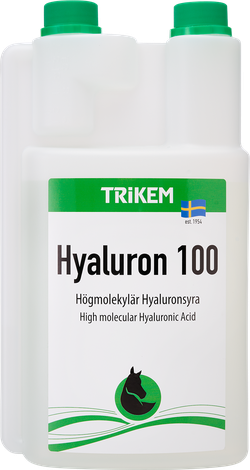
Hyaluron 100 1 liter VIMITAL® TRIKEM for joint
€154
Hyaluronic acid is present in the synovial fluid for shock-absorbing and lubricating function. The synovial fluid is also important for the supply of nutrients to the joint. Under load, the synovial fluid is normally consumed and loses its viscosity and lubricating function. During rest, the body forms new Hyaluron to restore the synovial fluid's properties.
If the body does not have time to regenerate a sufficient amount of Hyaluron, the lubricating and shock-absorbing function decreases and the wear on the joint increases. Horses that are exposed to a high training load or compete and train regularly.
Horses that are experienced as stiff or suffering from joint problems.
Can be given during rehabilitation after joint inflammation.
Hyaluronic acid is a body-specific substance that is included in the horse's synovial fluid. The ability of hyaluronic acid to absorb water and thereby increase the viscosity of the synovial fluid contributes to increasing the shock absorption of the joints and improving joint function. From the age of 12-14, horses produce a smaller amount of the body's own substances, which means that the joint's shock-absorbing ability can decrease in the older horse. Hyaluron 100 can advantageously be given to horses that are exposed to high loads, in the form of training or competition, as the body's own hyaluronic acid does not have time to be produced at the rate it is consumed.
Given to horses that are exposed to a high training load or compete and train regularly.
Or horses that are experienced as stiff or suffering from joint problems. And can also be given during rehabilitation after joint inflammation.
- BrandTrikem
Description
Article no.: 2036
Dosage
20 ml twice a day for 10 days.
Then 20 ml per day
CONTENTS per dose:
Hyaluronic acid
Sodium benzoate
Water
Files and media
 | Attached file |